


INTERVIEW Bettina Pelz
PUBLISHED 30 AUG 26
Lena Schnurrbusch’s practice is situated at the intersection of artistic production, curatorial practice, and exhibition design. Drawing on visual communication and spatial staging, she examines how research-based and theoretical inquiries may be articulated through material, visual, and spatial forms. The SEE DJERBA Festival gave her a platform to present her first architectural projection project.


// Which moment of the creative process do you enjoy the most?
I like to work through trial and error, following what feels right without always knowing where it will lead. Sometimes, while experimenting, something unexpected happens and adds another layer or deeper meaning to the original thought. Those are the moments I enjoy most — when something unexpected suddenly makes everything fall into place, all the different elements come together, and the work finds its own logic.
// How do you approach technology as artistic tools?
What I find exciting about digital tools is the range of possibilities they offer. They allow me to make things visible that might be difficult to express or experience otherwise. I can create a whole new world, or expand on things that already exist and explore what else they can become.
// What were your thoughts when you saw this year’s theme “AKROS – From Encounter to Entanglement?
I think it is a really powerful theme, especially when it comes to acknowledging the history of Tunisia. Creating a platform where people from different backgrounds come together and connect through art creates a very special kind of exchange. It’s an opportunity to form connections — between people, stories, and experiences. By coming together and encountering each other, we are already part of the theme. We all bring our own perspectives and interpretations, but still create something together. In that sense, we become entangled through the exchange and the shared experience.


// Please describe the work you brought to SEE DJERBA. What is the core idea? How did you develop?
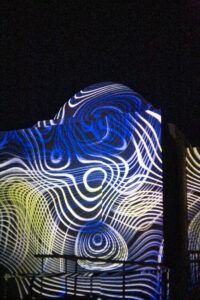
The idea for the work started while I was engaging with the work of Hannah Köchy and Jola Hauschild, whose pieces were going to be exhibited at SEE DJERBA. I also curated Hannah’s work for the exhibition and was particularly fascinated by the woven structures and started thinking about how I could translate something so physical and tactile into a digital form.
The idea of threads coming together and becoming connected felt closely related to this year’s theme. Just as we encounter one another in different contexts and become connected in different ways. I started animating in After Effects to experiment with how this kind of structure could move and transform, while individual threads form connections through the way they weave together. Together, they create something larger that can carry a story — just as our connections and encounters can.
In the work, the woven structure is continuously stretched, compressed, and distorted, transforming into different formations and states. As it changes, it doesn’t necessarily have to be read as a woven structure anymore. It can become something completely different, even something organic, while still carrying traces of where it came from.
This is also what I find exciting about working digitally: the structure can move through states and forms that would not be physically possible to create or show in the same way. It can stretch beyond the limitations of the physical material and become something that is constantly changing — without having to settle on one final form.
For me, the work became a way of exploring encounter and entanglement through material, structure, movement, and transformation — taking something physical as a starting point and allowing it to become something entirely different through digital means.
// How did you like the positioning of your work in Borj El Kebir?
The central space is the first thing visitors see when they enter the Borj, so it was very special to see Nicolas Gaupp’s work and mine come together and shape that first impression of the space. I enjoyed working with the architecture itself and using it as a surface for the projection. The building, with its forms and structure, became part of the work rather than just a background, which I loved.
We also wanted to create a story through the different works. It started with the individual glowing threads in Nicolas’ installation, which then led into my animated structure with more and more threads coming together. Further inside, this connection continued with the physical textile works by Hannah Köchy and Jola Hauschild.
// This was your first architecture projection project, is it something that you would like to continue to explore?
Absolutely. I really liked working with an existing architecture as a surface for projection — taking a space that already has its own character and history and using its forms as an open framework to play with. Every place gives the work a different effect and changes how it is perceived by the audience. I find this relationship between the work, the architecture, and the people experiencing it very interesting, and I would definitely like to continue exploring it.